How Hard Should You Push During a HIIT Workout? A Practical Guide
Nov 1, 2026
by Scott Binder
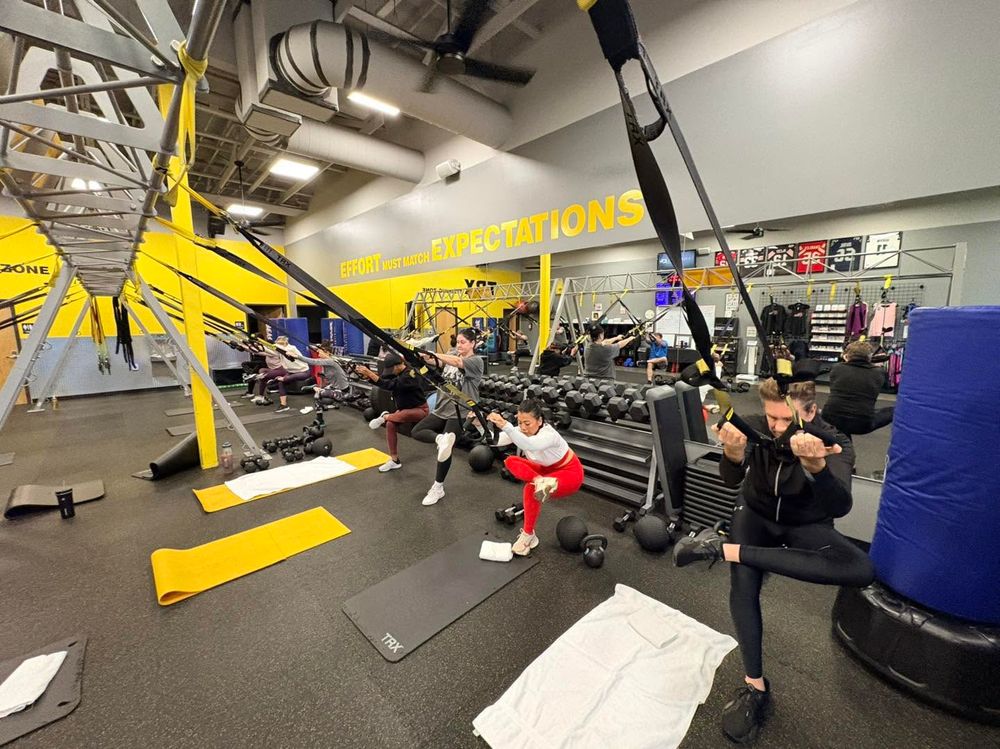
You walk into a HIIT class, the music starts, and everyone begins moving. Within minutes, your heart rate rises, your breathing gets heavier, and you start wondering: Am I working hard enough, or am I pushing too much?
You do not need to give 100% effort during every interval to benefit from HIIT training. The right intensity depends on your fitness level, the exercise, your experience, and how well you can maintain controlled movement.
At Results Fitness Training in Camas, WA, coached classes such as TRX Push HIIT, TRX Pull HIIT, Bootcamp, and Full Body HIIT combine resistance exercises with cardiovascular conditioning.
Understanding how to manage your effort can help you participate more confidently, choose appropriate modifications, and make your workouts more sustainable.
What Does Workout Intensity Actually Mean? 💪
Workout intensity describes how hard your body is working during an activity.
It is not simply how much you sweat, how fast you move, or how tired you feel afterward.
The Centers for Disease Control and Prevention explains that intensity can be measured relative to your own fitness level.
An activity that feels very challenging to someone returning to exercise might feel moderate to someone who has trained consistently for several years.
That is why comparing yourself with the person beside you is not particularly useful.
Your workout should challenge you at a level appropriate for your abilities.
Use the Effort Scale to Guide Your Workout
One practical way to measure exercise intensity is the Rate of Perceived Exertion, often called RPE.
The CDC describes a scale from 0 to 10, where 0 represents resting, and 10 represents maximal effort.
| Effort level | How it feels | Practical example |
|---|---|---|
| 2 to 3 | Easy and comfortable | Gentle warm-up or relaxed walking |
| 4 | Noticeable effort | Light conditioning or controlled movement |
| 5 to 6 | Moderate effort | Challenging but sustainable activity |
| 7 to 8 | Vigorous effort | Hard intervals requiring greater concentration |
| 9 to 10 | Very hard to maximal | Effort that is difficult to sustain |
The CDC generally places moderate aerobic intensity around 5 to 6 and vigorous aerobic intensity around 7 to 8.
These are useful reference points, not targets you must reach during every exercise.
In a HIIT class, effort will naturally change between challenging intervals, recovery periods, and strength movements.
Try the Talk Test During Cardio Intervals 🗣️
You do not need an expensive fitness watch to estimate aerobic intensity.
The talk test is a simple option.
According to the CDC:
-
During moderate aerobic activity, you can usually talk but not sing.
-
During vigorous aerobic activity, saying more than a few words without pausing for breath becomes difficult.
Imagine you are completing a conditioning interval during Bootcamp.
If you can comfortably hold a long conversation, the activity may be relatively easy for you.
If speaking becomes difficult, you are probably working at a vigorous intensity.
However, the talk test is most useful during continuous aerobic activity. It is less informative during short resistance exercises such as kettlebell lifts or TRX rows.
During those exercises, movement control and appropriate resistance are equally important.
What Intensity Should You Aim for in a HIIT Class?
There is no single effort level that every participant should maintain.
A well-structured HIIT session typically alternates more challenging periods with opportunities to recover.
The appropriate challenge depends on the exercise and the session's purpose.
During the Warm-up
Start at a comfortable intensity.
Use the warm-up to gradually increase your movement, practice the exercises, and prepare for more challenging activity.
You should not need to exhaust yourself before the main workout begins.
During Strength Exercises
Focus on controlled repetitions and appropriate resistance.
If you are performing a TRX row, for example, changing your body position can alter how challenging the movement feels.
Choose a variation that allows you to complete the exercise with good control.
During Cardio Intervals
You may work at a vigorous intensity when it is appropriate for your fitness level and the coach's instructions.
However, reaching maximal effort during every interval is not necessary.
During Recovery Periods
Allow your breathing and effort to decrease.
Recovery periods are part of interval training, not an opportunity you have failed to use.
How Results Fitness Training Makes HIIT Adaptable
Results Fitness Training offers several class formats that allow participants to experience different types of challenges.
Its TRX Push HIIT and TRX Pull HIIT classes combine suspension training with cardiovascular intervals.
TRX Push HIIT emphasizes movements involving the chest, shoulders, triceps, core, and quadriceps.
TRX Pull HIIT emphasizes pulling movements involving the back, biceps, glutes, and hamstrings.
Both formats incorporate conditioning, but the exercises and muscular emphasis differ.
The studio's Bootcamp classes combine functional strength exercises with cardiovascular intervals and bodyweight movements.
Depending on the session, equipment may include dumbbells, kettlebells, TRX straps, slam balls, and battle ropes.
Meanwhile, Full Body HIIT combines timed cardiovascular intervals with functional strength exercises.
The business describes these classes as coached and scalable for different fitness levels.
That matters because you can participate in the same general class format while using an exercise variation or intensity that better matches your ability.
Five Signs You May Need to Reduce the Intensity ⚠️
Learning when to adjust your workout is a valuable skill.
Consider reducing the challenge or asking your coach for a modification when:
1. Your technique becomes difficult to control.
If your posture or movement quality consistently deteriorates, consider reducing resistance, speed, or repetitions.
2. You cannot complete the movement as instructed.
A different exercise variation may be more appropriate than forcing additional repetitions.
3. You are unable to recover sufficiently between intervals.
If each interval becomes progressively less manageable, communicate with your coach about adjusting the work or recovery period.
4. The exercise causes pain rather than normal muscular effort.
Stop the painful movement and seek appropriate guidance. Do not attempt to push through sharp or concerning pain.
5. You experience unusual symptoms.
Chest pain, faintness, or severe unexpected breathlessness warrant stopping exercise and seeking appropriate medical assessment. Severe or persistent symptoms may require emergency care.
Reducing intensity is not necessarily giving up on a workout. It can be an appropriate adjustment that allows you to train at a suitable level.
A Practical Example of Managing HIIT Intensity
Imagine a hypothetical participant attending a Full Body HIIT class.
The workout includes squats, rows, and cardiovascular intervals.
Instead of trying to complete every movement as quickly as possible, the participant uses the following approach:
First interval: Start at a moderate effort to understand the movement and pace.
Second interval: Increase the challenge slightly if the first interval felt controlled.
Third interval: Maintain a challenging but manageable effort rather than trying to outperform other participants.
Recovery period: Allow breathing to settle and prepare for the next exercise.
Final interval: Continue at an appropriate intensity, even if that means slowing down or using a modification.
The exact interval structure would depend on the coach's programming. This example illustrates effort management rather than a specific Results Fitness Training workout.
Why Harder Is Not Always Better
Physical activity provides benefits across different intensity levels.
The CDC's adult activity guidelines recommend at least 150 minutes of moderate aerobic activity each week, or 75 minutes of vigorous activity, or an equivalent combination.
Adults are also encouraged to complete muscle strengthening activities on at least two days each week.
You do not need to perform every workout at vigorous intensity to work toward those recommendations.
Walking, moderate conditioning, resistance training, and more demanding sessions can all contribute to a balanced fitness routine.
Results Fitness Training also offers Yoga and Stretch classes, providing additional ways to include movement and flexibility work alongside higher-intensity sessions.
Questions to Ask Your Coach Before Class
If you are unsure how hard you should work, ask your coach:
-
Which exercises should feel most challenging today?
-
How can I modify this movement if I lose control?
-
Should I prioritize resistance, repetitions, or movement quality?
-
How much recovery should I allow between intervals?
-
What is a suitable starting variation for my current fitness level?
These questions help you understand the purpose of the session rather than simply trying to survive it.
Frequently Asked Questions
Should I feel exhausted after every HIIT workout?
No. Feeling challenged is normal, but complete exhaustion is not required for an effective session. The appropriate effort depends on the workout, your fitness level, and your recovery.
Is HIIT suitable for beginners?
It can be, when exercises and intensity are appropriately modified. Results Fitness Training describes its coached HIIT formats as scalable for different fitness levels. Beginners should start with manageable effort and communicate their experience level to the coach.
Do I need a heart rate monitor?
Not necessarily. A heart rate monitor can provide useful information, but perceived effort and the talk test can also help estimate aerobic intensity.
Can I combine HIIT with strength training?
Yes. Some classes already combine resistance exercises with cardiovascular intervals. The best weekly mix depends on your goals, current fitness, and recovery.
Make Every Workout Count
An effective HIIT workout is not a competition to see who can finish the most exhausted.
It is an opportunity to challenge yourself appropriately, practice quality movement, and develop fitness over time.
Learning to recognize your effort and make adjustments can help you become more confident during coached training.
If you are interested in experiencing TRX, Bootcamp, or Full Body HIIT in Camas, Results Fitness Training currently offers three free introductory classes so new clients can explore the coaching and find a class that fits their needs.
